
Quality is managed throughout the project lifecycle—from PCB design review and manufacturing coordination to component sourcing, in-house SMT assembly, inspection, documentation and final delivery.
Our approach focuses on production readiness, repeatability, traceability and clear engineering communication.
From PCB design review to final PCBA delivery
Engineering controls · Manufacturing coordination · SMT inspection · Traceability
Excel Circuit
Reliable hardware starts before fabrication. Our PCB design engineers consider manufacturability, assembly requirements, signal and power integrity, component placement, routing constraints and production requirements before design release.
Schematic, layout and project requirements are reviewed before production release.
Manufacturing and assembly considerations are incorporated into design decisions.
Design files, BOM revisions and production data should remain aligned throughout the project.
Design outputs are prepared with downstream fabrication and assembly requirements in mind.
PCB fabrication is coordinated through qualified manufacturing resources selected according to project technology, layer count, materials, process requirements and delivery needs.
Resources are selected according to layer count, materials, HDI, RF, heavy copper or other project requirements.
Gerber, drill, stackup and fabrication requirements are reviewed before release.
Technical questions and production exceptions are coordinated during fabrication.
PCB quality documentation and incoming boards are reviewed according to project requirements before assembly.
Component sourcing is supported as part of turnkey PCBA projects, with BOM review, approved-alternative control and project-specific incoming checks.
Review part numbers, quantities, package information and sourcing requirements.
Approved alternatives are used only when confirmed according to project requirements.
Availability, lifecycle or lead-time risks are identified where applicable.
Components may be checked according to packaging, labeling, quantity and project requirements before assembly.
In-house SMT assembly connects production data, materials and process inspection within a controlled build workflow. Inspection stages are selected according to project requirements, package type and assembly complexity.
X-ray inspection may be used for BGA, QFN or other hidden solder joints where applicable.
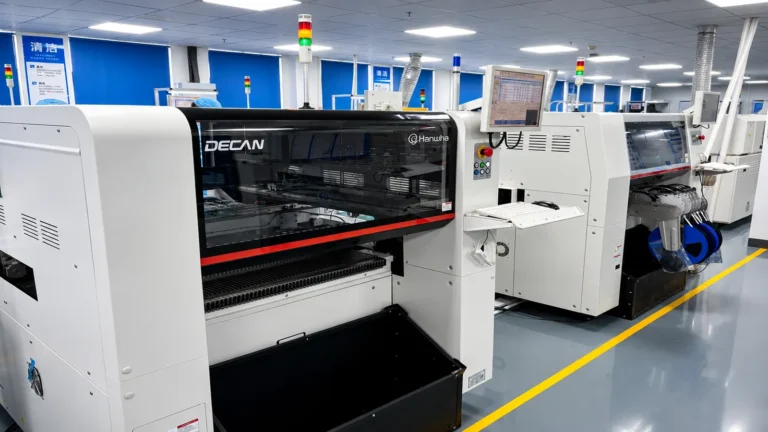
Paste preparation and printing are controlled according to process requirements.
Solder paste inspection may be used to verify print quality where applicable.
Placement data and machine setup are aligned with the approved assembly files.
Reflow settings are established according to the assembly and component requirements.
Automated optical inspection checks placement and visible solder conditions where applicable.
Hidden joints such as BGA or QFN may be inspected by X-ray according to project needs.
Manual checks support visual verification and special assembly requirements.
Assembly output and required records are reviewed before release.
Inspection provides project-specific quality gates from incoming materials through assembly release.
Fabrication output and incoming PCB requirements are reviewed for the build.
Components and materials are checked according to project needs.
SPI, AOI and X-ray are applied where appropriate to the assembly.
Visual and documentation review is completed before delivery.
Inspection and testing plans vary according to product complexity, package type and customer requirements.
A connected workflow helps keep engineering data, materials, production activity and inspection requirements aligned from design review through delivery.
Review requirements and design data before release.
Align design decisions with fabrication and assembly needs.
Coordinate qualified resources and production questions.
Review incoming items according to project requirements.
Build assemblies using approved production data.
Apply process inspection as applicable.
Review assembly output before release.
Align available production and inspection records.
Release the completed build for delivery.
Traceability helps ensure that the files, materials and production records associated with a build remain aligned with the approved project revision.
Approved schematic and PCB design revisions are identified for the build.
Part numbers, quantities and approved changes remain linked to the applicable revision.
Released Gerber, drill, stackup and fabrication notes are controlled as project data.
Assembly files and production information are associated with the applicable build.
Available inspection and production records support project-level review where applicable.
PCB and PCBA projects often evolve during prototyping and NPI. Changes should be reviewed before implementation so design files, BOM data, manufacturing instructions and assembly requirements remain synchronized.
An engineering, sourcing or production issue is documented.
Impact on PCB data, BOM, assembly, cost and delivery is reviewed.
Approved updated files are used for the next production build.
When a quality issue occurs, the priority is to identify the affected scope, contain the issue, investigate the cause and define appropriate corrective actions.
The affected condition and available evidence are recorded.
The affected scope is identified and appropriate containment is considered.
The cause is investigated using the information available for the issue.
Appropriate corrective actions are defined, including NCR or CAPA where applicable.
Follow-up confirms whether the selected action addresses the issue.
Share your project requirements, Gerber files, BOM or design documentation with our team for engineering review and quotation.
Download the Excel Circuit Quality Assurance Whitepaper for a detailed overview of our approach to engineering review, manufacturing coordination, component sourcing, in-house SMT assembly, inspection, traceability and delivery.