Contents
A bill of materials can be electrically correct and still be risky to build. BOM risk analysis identifies lifecycle, lead-time, allocation, single-source, minimum-order, packaging and data-quality problems before a quotation or production schedule is committed.
The review should flag EOL or NRND parts, constrained supply, unique packages, unclear manufacturer part numbers, high MOQ, fragmented availability, lifecycle mismatch and uncontrolled substitutions. It turns a parts list into a supply plan without replacing engineering judgment.
| BOM risk | Why it matters | Typical mitigation |
|---|---|---|
| EOL or obsolete | Future supply may be unavailable | Alternate, redesign or last-time-buy review |
| NRND | Future lifecycle exposure | Evaluate a supported successor |
| Long lead time | Schedule may slip | Early sourcing or an approved alternate |
| Single source | Supply is concentrated | Second-source review |
| High MOQ | Excess inventory and cost | Quantity and packaging review |
| Allocation | Confirmed quantity is uncertain | Supply confirmation and schedule planning |
| Incomplete MPN | Wrong-part and quote errors | BOM normalization |
| Proprietary/custom part | Replacement may be difficult | Lifecycle and inventory planning |
What is BOM risk analysis?
BOM risk analysis is a structured review of whether every required component can be identified, sourced and sustained for the intended production plan. It evaluates production continuity and sourcing feasibility in addition to component function.
The output should identify open questions, evidence, owners and possible mitigations. It should not silently replace parts or reduce an engineering decision to a database score.
Lifecycle risk
Lifecycle status describes a manufacturer’s current commercial position for a part. Common labels include Active, Not Recommended for New Designs (NRND), End of Life (EOL) and Obsolete. Definitions and update timing can vary among manufacturers and data providers, so confirm consequential decisions with the manufacturer or an authoritative notice.
An active part may still have limited short-term availability, while an NRND part may remain orderable for an existing program. EOL commonly requires a last-time-buy, alternate or redesign decision. When a part has already become difficult to source, use the obsolete and hard-to-find component guide for the broader response. Manufacturer terminology should be checked directly; TI’s product lifecycle definitions, for example, distinguish NRND, last-time-buy and obsolete status.
Lead-time and allocation risk
Lead-time risk is the possibility that components cannot arrive before the planned build. Separate visible distributor stock, supplier lead time, factory lead time and confirmed allocation. A quoted lead time can change and is not equivalent to reserved inventory.
Review the required-on-site date, purchasing approval time, incoming inspection and kitting needs. Do not invent a standard lead time; obtain current confirmation for the quantity, packaging and delivery location in the project.
Single-source components
A single-source component has no approved equivalent supply path for the relevant application. Causes include a sole manufacturer, proprietary function, unique package, custom programming, specialized connector geometry or customer qualification.
Single source does not automatically mean unacceptable. A stable proprietary device may be essential to the product. The review should expose the concentration, lifecycle and recovery options so the team can choose inventory, redesign, forecast or supplier controls deliberately.
Approved alternates and substitution control
An approved vendor or manufacturer list records permitted supply sources, while an approved alternate records a component substitution accepted for a defined use. Exact document names and controls differ among organizations.
A purchasing system should not treat a suggested cross-reference as approval. Engineering must compare the replacement against the design. The alternate-component evaluation guide explains package, pinout, electrical, thermal and firmware review. Keep source authorization and technical substitution approval distinct in the purchasing records.
MOQ and packaging risk
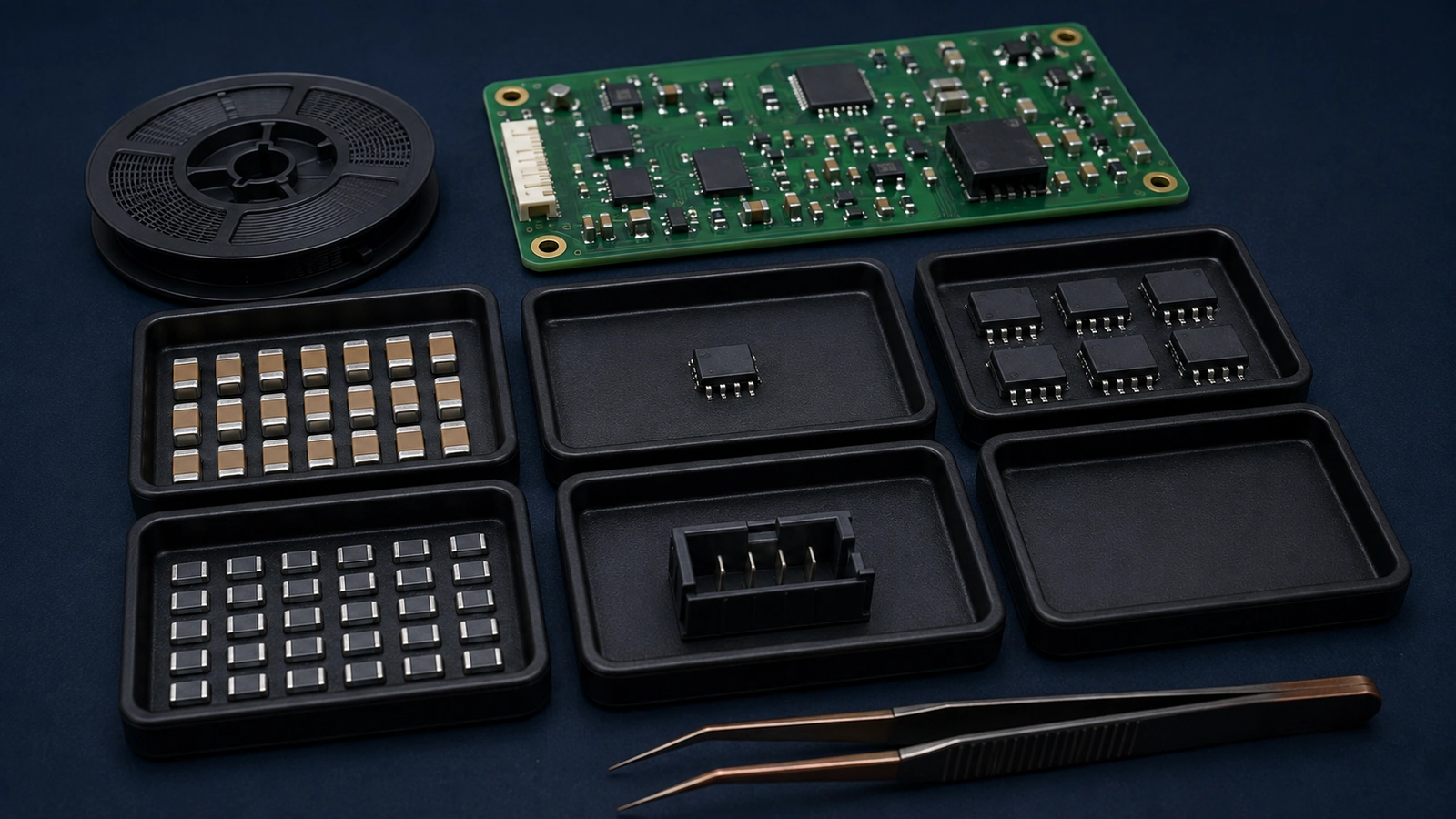
Minimum order quantity and packaging can make an available part commercially impractical. Full reels may reduce handling and placement risk but exceed prototype demand; trays, tubes or cut tape can have different quantities, condition and machine-feeding implications.
Compare required quantity, attrition allowance, order multiple, shelf-life constraints and future consumption. Do not change packaging or accept excess inventory automatically. Detailed packaging selection belongs in its dedicated production review.
Price volatility and quote validity
Component pricing can move when supply is constrained, a part is obsolete, purchase quantity changes or a quote expires. A BOM review should state the pricing basis, quantity, source assumptions and validity period instead of presenting an estimate as permanent.
High price is a signal to investigate, not proof of a bad source. Review alternative quantities and approved parts without making unsupported market forecasts.
BOM data quality
A sourceable BOM should state manufacturer, full manufacturer part number, description, quantity, reference designators, package and any do-not-install or do-not-populate designation. Approved alternates and restrictions should be explicit.
Partial MPNs can omit package, temperature, speed, tolerance, finish or packing suffixes. Missing references obstruct quantity checks, and inconsistent descriptions create quote ambiguity. Normalize the data before availability research so every result maps to the intended item.
Duplicate and equivalent parts
Unnecessary BOM diversity can increase line items, MOQ exposure and setup complexity. Examples include same-value passives split across multiple part numbers or footprints without a design reason.
Consolidation can be useful, but only after engineering review of tolerance, voltage, dielectric, power, physical size and circuit role. A database match on value and package is not sufficient authorization.
Potentially high-risk component categories
MCUs, FPGAs, processors, memory, power modules, sensors, specialty analog devices, connectors and custom magnetics often deserve close review because they may combine long qualification cycles, firmware dependence or limited equivalents. This does not make every part in these categories high risk.
Prioritize components by their actual lifecycle, source concentration, schedule effect and redesign effort. A low-cost connector with unique mechanics can be more critical than an expensive but widely supported device.
Production quantity and forecast
Risk changes with the build plan. Prototype quantity may be covered by limited stock but provide no path to a pilot or repeat production. High-volume demand may justify factory scheduling while increasing MOQ, allocation and working-capital exposure.
Provide prototype, pilot and expected production quantities plus the forecast horizon. The prototype-versus-production PCBA guide explains why controls and evidence should mature with the build stage.
How BOM risk affects a PCBA quotation
Unresolved sourcing assumptions can change quotation validity, component cost, schedule and the need for alternate pricing or engineering work. A quote should distinguish confirmed inputs from allowances or open items.
Component cost is only one part of the PCB assembly cost structure. The turnkey PCBA process also depends on data review, fabrication, assembly and testing coordination.
Qualitative BOM risk classification
A qualitative classification can help teams prioritize review. Low risk may indicate complete data and an adequate confirmed path. Medium risk may require monitoring or an alternate. High risk may threaten schedule, cost or continuity. Critical risk may stop the planned build until a decision is made.
Classification should combine several factors: lifecycle evidence, availability, source concentration, forecast coverage, engineering impact and qualification. These labels are project-specific and must not be presented as universal numerical thresholds.
| Class | Typical interpretation | Review response |
|---|---|---|
| Low | Evidence supports the current plan | Record and monitor |
| Medium | Manageable uncertainty exists | Confirm supply or prepare options |
| High | Schedule, cost or continuity is exposed | Assign mitigation and owner |
| Critical | The build lacks an acceptable path | Escalate before commitment |
BOM risk mitigation workflow
- Normalize descriptions, quantities and reference designators.
- Verify each manufacturer and complete MPN.
- Check lifecycle using authoritative evidence.
- Check current availability and relevant lead time.
- Identify sole-manufacturer, unique and custom parts.
- Review MOQ, order multiples and packaging.
- Record existing approved alternates.
- Escalate unapproved substitutions to engineering.
- Compare supply coverage with build quantities and forecast.
- Document assumptions, decisions, owners and review dates.
BOM risk review checklist
A useful risk register keeps one row per affected MPN rather than one vague warning for the whole assembly. Record the BOM revision, reference designators, required quantity, lifecycle source and check date, availability evidence, approved alternate, risk class, owner, action and next review date. This makes the review reproducible and prevents old stock observations from being mistaken for current supply commitments.
Separate evidence from assumptions. A distributor listing is evidence of a displayed quantity at a point in time; it is not proof that the material is reserved, in the required packaging, eligible for the customer’s sourcing policy or sufficient for repeat demand. A supplier commitment should state what is confirmed and what still depends on order placement or factory allocation. Record quote validity and any cancellation constraints before financial approval.
Consider a pilot build with a microcontroller available for the first batch but no confirmed route for the next production release. The initial build may remain feasible while production continuity is high risk. The team might secure a qualified supply commitment, prepare an approved alternate or plan a redesign. The appropriate choice depends on forecast confidence, engineering effort and the consequence of interruption; simply marking the line green because some stock exists would hide the problem.
Conversely, a low-cost connector with a high MOQ may create more excess material than the pilot requires. That is a commercial and inventory issue, not automatically an electrical design defect. Purchasing can compare packaging and order quantities while engineering preserves mating and footprint requirements. Assigning the correct owner keeps sourcing questions from becoming unnecessary redesigns and prevents purchasing from making technical substitutions without approval.
Close each risk only when its evidence and approval are recorded. “Alternate found” is not closure if engineering has not qualified it; “supplier quoted” is not closure if the required delivery date remains unconfirmed. Reopen the review when the BOM revision, volume, schedule, lifecycle notice or supply commitment changes. The review frequency should follow the program’s exposure, not a universal calendar interval.
Where the supply plan requires less-direct channels, use the component traceability and counterfeit-prevention guide to define appropriate provenance and incoming controls. That authenticity review complements the BOM risk register without replacing lifecycle or engineering decisions.
- Data quality: manufacturer, full MPN, quantity, references, package and DNP status are complete.
- Lifecycle: Active, NRND, EOL or Obsolete evidence is recorded.
- Supply: stock, lead time, allocation and required date are distinguished.
- Sourcing: approved channels and source concentration are known.
- Alternates: options are identified without bypassing engineering approval.
- Packaging: reel, tray, tube, cut tape, MOQ and excess are reviewed.
- Forecast: prototype, pilot, production and repeat demand are considered.
- Qualification: customer and application restrictions are captured.
- Documentation: open risks, mitigations, owners and approvals are retained.
Information required from the customer
Provide the BOM with full manufacturer part numbers, approved manufacturers and alternates, target and forecast quantities, production schedule and current build stage. Identify lifecycle restrictions, sourcing constraints, customer-supplied inventory and any certification or qualification controls.
Excel Circuit’s component sourcing and BOM service can normalize this information and review availability, lifecycle and sourcing assumptions before PCBA production.
Review BOM risk before quotation
Send your BOM, production quantity and sourcing constraints if you need lifecycle, lead-time and single-source risks reviewed before quotation. A clear forecast and approval policy make the resulting supply plan more useful.